


Content Menu
● Global Power Strip Market Size, Share & Forecast 2025–2033
● Why Demand Keeps Rising: An Expert View of Real Buyer Pain Points
● Product Type Insights: Standard Multi-Outlet vs Smart Power Strip
>> Standard Power Strip & Extension Lead Still Dominate Volume
>> Smart Power Strip: Fastest Growth, Highest Scrutiny
● Expert Guide: How Many Joules Does Your Power Strip Really Need?
● Protection Features That Actually Matter in the Field
● Application Insights: Power Strip for Office, Home, Industrial & Data Center
>> Commercial & Office Environments
>> Industrial & Harsh Environments
● What Goes Wrong When Buyers Under-Specify: Lessons from the Field
● Practical Decision Checklist for Buyers
● How to Choose a Reliable Power Strip Manufacturer
● Looking Ahead: Matter, USB-C PD and Energy Transparency
● Summary & Recommended Next Steps
After more than a decade working with facility managers, OEM buyers and electrical safety engineers, one pattern remains constant: the simple power strip is rarely simple. What looks like a basic electrical power strip or extension lead with sockets is, in practice, a critical safety and uptime component. Whether you need a multi outlet power strip for an open office, a power strip with switch for a home desk, or an extension cord with multiple outlets for industrial tools, the right choice depends on real-world protection performance, certifications and supplier reliability—not just price or outlet count.a
This analysis combines publicly available market data, recognized safety standards and front-line procurement experience. It is written for buyers who must justify decisions to finance, safety and operations teams, and for manufacturers who want to understand what professional customers actually value.

Global Power Strip Market Size, Share & Forecast
Independent estimates place the global power strip market in the range of approximately USD 12.5–14.0 billion in the mid-2020s. Consensus projections show the market expanding to roughly USD 17.5–21.5 billion by the early 2030s, implying a compound annual growth rate in the mid-to-high single digits (commonly cited figures fall between 5.7% and 6.5–7%).
Key directional findings across major reports:
- North America consistently holds the largest regional share (around 33–35% in recent base years), driven by high device density, strict safety culture and early smart-home adoption.
- Asia-Pacific is repeatedly identified as the fastest-growing region, supported by urbanization, rising disposable income and expanding manufacturing and data-center infrastructure.
- Standard / common power strips still account for the majority of volume (often 55–58%), while smart power strip models post the highest growth rates.
- Surge-protected models dominate the protection-feature segment and are the default expectation in professional environments.

Why Demand Keeps Rising: An Expert View of Real Buyer Pain Points
In facility walk-throughs and sourcing discussions, the conversation rarely starts with "we need more outlets." It starts with overloaded wall sockets, unexplained equipment failures, or the inability to power a new bank of monitors and docking stations without daisy-chaining. Three structural forces are at work:
1. Device density explosion. A typical knowledge-worker desk now supports a laptop, one or two monitors, docking station, phone, headset, desk lamp and often a mini-PC or NAS. Fixed wall receptacles cannot scale economically.
2. Safety and uptime awareness. Once a company experiences a surge-related hard-drive failure or a production-line stoppage, the conversation shifts permanently from "cheapest strip" to "certified surge protector power strip with documented joule rating and circuit-breaker protection."
3. Smart-building and energy mandates. Facility teams increasingly want visibility into plug-load consumption. A basic multi-outlet unit cannot deliver that data; a connected smart power strip can.
Product Type Insights: Standard Multi-Outlet vs Smart Power Strip
Standard Power Strip & Extension Lead Still Dominate Volume
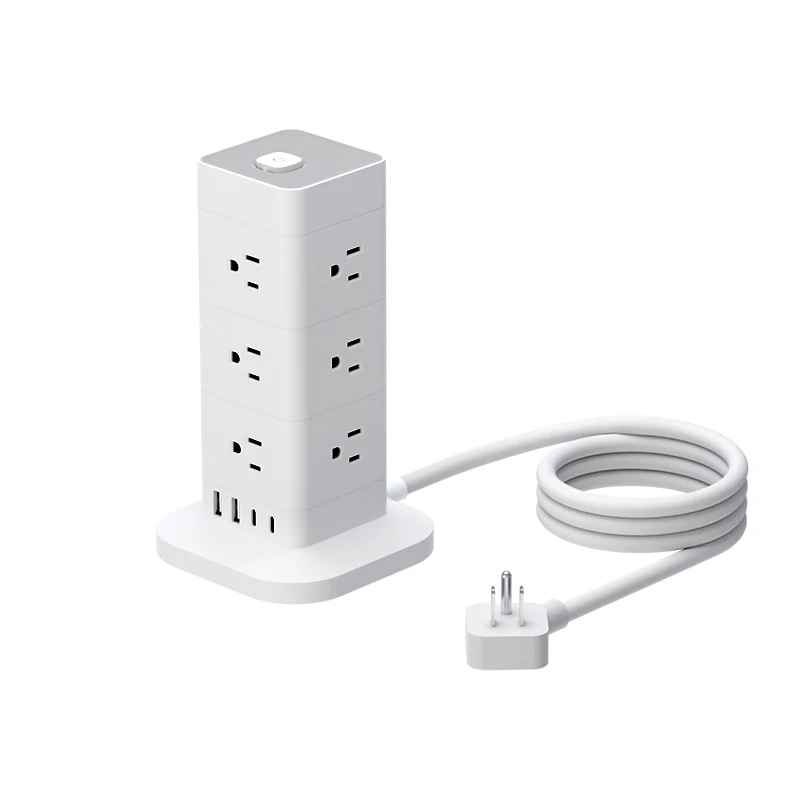
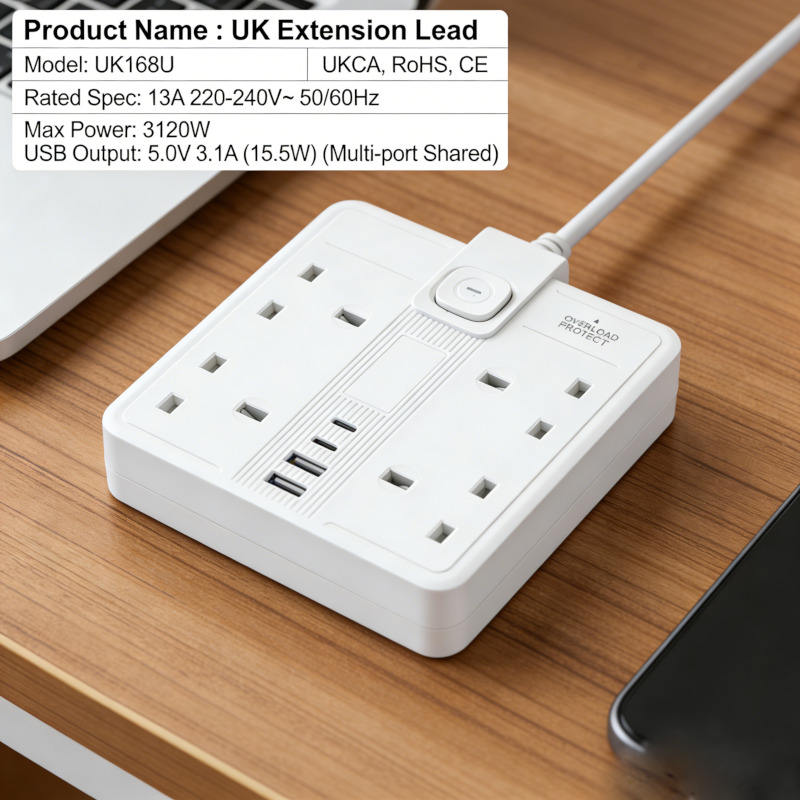
The conventional multi outlet power strip and extension lead with sockets remain the workhorses of the market. Their advantages are straightforward: lower unit cost, universal compatibility, and zero learning curve. For many residential and light-commercial applications a well-built unit with a power strip with switch, adequate cord length and basic overload protection is still the rational choice.
Smart Power Strip: Fastest Growth, Highest Scrutiny
Smart models are expanding at a higher CAGR (frequently cited in the 6–9% range for the smart segment). In practice, buyers pay for four capabilities:
- Remote on/off and scheduling via app or voice assistant
- Per-outlet or whole-strip energy monitoring
- Integration with platforms such as Alexa, Google Home or Matter
- Reliable overload and surge protection that does not depend on the smart features remaining online
From an expert standpoint, the most common disappointment is instability or abandoned firmware. A smart strip that loses connection or never receives security updates quickly becomes a liability. Prefer suppliers with a demonstrated update history and clear Matter or major-platform roadmaps.
Expert Guide: How Many Joules Does Your Power Strip Really Need?
One of the most frequent questions from procurement and IT teams is "What joule rating is enough?" There is no single magic number, but real-world practice and safety literature converge on useful ranges. A high joule surge protector buys more cumulative protection before the metal-oxide varistors (MOVs) wear out.
| Typical Environment | Recommended Joule Range | Additional Notes |
|---|---|---|
| Basic home / phone & small peripherals | 800–1,500 J | Minimum viable; still prefer UL 1449 listing |
| Home office (laptop + 1–2 monitors) | 2,000–3,500 J | Common professional recommendation range |
| Full desk / AV / high-value electronics | 3,500–4,000+ J | Look for equipment protection policy from maker |
| Data center / critical commercial | High joule + circuit breaker + monitoring | Often rack PDU rather than consumer strip |
Always verify that the unit is listed to UL 1449 (Surge Protective Devices) in addition to the relevant power-tap standard (UL 1363 for relocatable power taps or UL 962A for furniture power distribution units). A power strip with surge protection that lacks proper listing is marketing, not protection.

Protection Features That Actually Matter in the Field
A surge protector power strip remains the dominant protection category. Lightning, utility switching and internal building faults all generate transients that can destroy electronics or corrupt data. In commercial and high-value residential settings, surge protection has moved from "nice to have" to baseline specification.
An overload protected power strip or power strip with circuit breaker adds a second, equally important layer. Thermal or magnetic circuit breakers that can be reset after a trip are preferred over one-time fuses in most office and light-industrial applications. The combination of surge suppression plus reliable over-current interruption is what professional buyers increasingly demand.
Application Insights: Power Strip for Office, Home, Industrial & Data Center
Commercial & Office Environments
A power strip for office use must survive higher ambient temperatures, repeated plug cycles and the occasional coffee spill. Steel housings, spaced outlets that accept large power bricks, and full UL/ETL/CSA documentation are the practical differentiators. Energy-monitoring smart models are gaining traction where sustainability reporting is required.
Residential / Home
Home buyers prioritize safety, USB-C fast charging and clean cable management. A power strip for home that combines solid surge protection with modern USB-C Power Delivery ports solves two problems at once: protecting gear and reducing wall-wart clutter.
Industrial & Harsh Environments
Industrial users need robust cordage, higher current ratings and often metal enclosures. An industrial-grade extension cord with multiple outlets or heavy-duty multi-outlet assembly is specified far more carefully than a consumer strip.
Data Centers & Critical IT
Here the conversation usually moves beyond consumer-style strips to rack-mount PDUs with outlet-level metering, remote switching and higher power densities. Still, edge closets and small server rooms continue to use high-quality power strip for data center style products that meet strict listing and monitoring requirements.
What Goes Wrong When Buyers Under-Specify: Lessons from the Field
Three recurring patterns appear in post-incident reviews:
1. Unlisted or marginally listed products. A strip that carries only a generic "CE" self-declaration or an outdated mark may fail under fault conditions that a properly tested UL 1363 / UL 1449 unit survives. The cost of one damaged server or production tool usually exceeds the savings on an entire year's strip purchases.
2. Daisy-chaining and overloaded circuits. Even a high-quality unit cannot overcome an upstream circuit that is already near capacity. Facility teams must treat power strips as part of the building electrical system, not as unlimited expansion devices.
3. Abandoned smart features. Cloud services shut down, apps stop receiving updates, or Matter migration is never completed. The hardware remains, but the promised energy data and remote control vanish. Choose partners with transparent support timelines.
Practical Decision Checklist for Buyers
- Confirm current safety listings (UL 1363 / UL 962A + UL 1449 where surge protection is claimed; CSA, CE, BIS as required by destination market).
- Match joule rating and circuit-breaker type to the value and criticality of connected equipment.
- Evaluate total cost of ownership — failure rate, replacement cycle, potential downstream equipment damage, and energy waste.
- For smart models, demand evidence of ongoing firmware and platform support.
- Require batch consistency and full documentation when ordering OEM or private-label volumes.
How to Choose a Reliable Power Strip Manufacturer
When sourcing power strips in bulk, buyers should evaluate not only product pricing but also the capabilities of the power strip manufacturer. A reliable power strip supplier should provide consistent quality control, appropriate safety certifications and the ability to support OEM or customized projects.
For buyers sourcing OEM power strips, custom extension leads or private-label products, production consistency and compliance documentation are often more important than the lowest initial purchase price. Key evaluation points include:
- Certification breadth and depth — current UL, CSA, CE, ETL or equivalent listings plus the ability to supply full test reports.
- Process control — documented incoming inspection, in-process checks and finished-goods testing that deliver batch-to-batch consistency.
- OEM / ODM flexibility — willingness and competence to adapt outlet layout, cord specification, housing, branding and, for smart models, firmware without compromising safety.
- Engineering partnership — help navigating regional regulatory differences rather than simply offering a catalog item.
- After-sales and longevity mindset — especially critical for connected products.
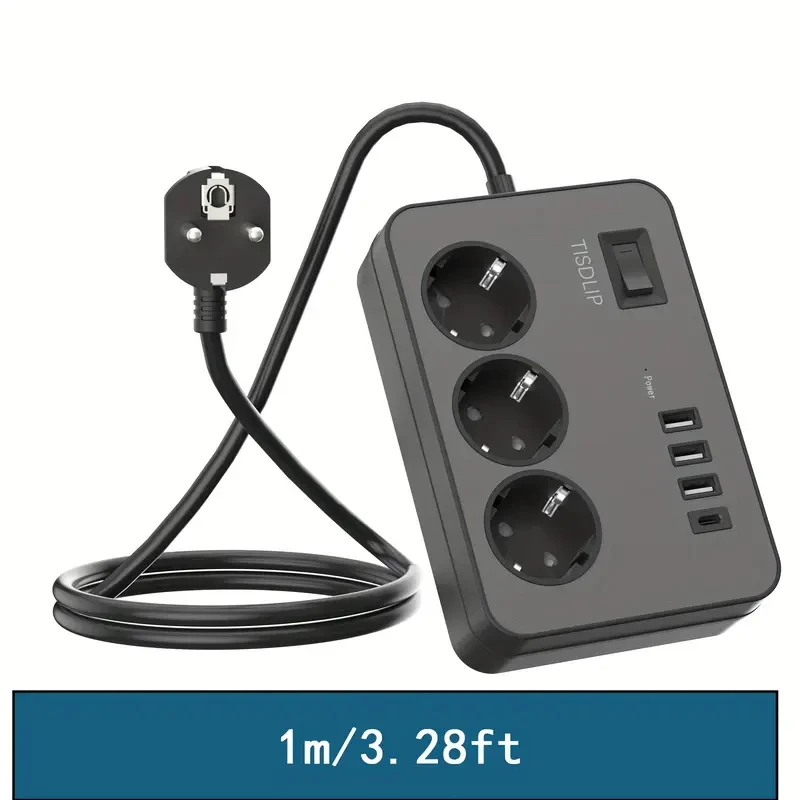
Manufacturers such as TISDLIP Power Strip that combine solid safety credentials with flexible OEM support and a balanced portfolio of standard and advanced protection models illustrate the profile many professional buyers seek. Selecting a power strip manufacturer or extension lead manufacturer is ultimately about securing a partner that can deliver compliant, consistent product over the life of the program.
Looking Ahead: Matter, USB-C PD and Energy Transparency
Three technology threads are reshaping specifications in 2026 and beyond:
- Matter compatibility reduces platform lock-in for smart strips and improves long-term usability across Apple, Google and Amazon ecosystems.
- High-wattage USB-C Power Delivery (65 W and above) is rapidly becoming expected on desk-oriented models, allowing users to leave laptop bricks at home.
- Granular energy monitoring supports corporate ESG reporting and helps facilities identify vampire loads. Buyers who specify these capabilities today are future-proofing their deployments.
Summary & Recommended Next Steps
The power strip market is maturing from a commodity multi-outlet accessory into a safety- and data-aware category. Standard volume products will continue to serve cost-sensitive applications, while surge protector power strip and smart power strip solutions capture the higher-value commercial, data-center edge and premium residential segments.
Actionable next steps for buyers:
1. Audit current installed base for listing status, joule ratings and daisy-chain practices.
2. Update procurement specifications to require current UL/CSA/CE documentation and minimum joule thresholds matched to equipment value.
3. When evaluating new suppliers or OEM partners, score them on certification depth, process control and long-term support—not solely on unit price.
4. Pilot one or two Matter-ready or high-wattage USB-C models in a controlled environment before broad rollout.
Ready to review specifications or request samples from a manufacturer that meets professional-grade requirements? Contact a qualified power strip manufacturer or extension lead manufacturer with your target markets, volume and certification needs. Clear requirements produce better proposals and fewer downstream surprises.
References & Data Sources
Market size and growth figures are synthesized from the following publicly accessible sources. Readers are encouraged to consult the original reports for full methodology and segmentation detail.
1. [Grand View Research – Power Strip Market Size & Outlook] (global size estimates and regional shares).
2. [GlobeNewswire / Grand View Research release – Power Strip Market Size, Share & Trends Analysis Report] (2025–2030 outlook, segment highlights).
3. [Mordor Intelligence – Power Strip Market Size, Trends, Growth & Competitive Landscape] (2025–2031 projections and end-user insights).
4. [UL Standards – UL 962A Standard for Safety: Furniture Power Distribution Units] (current safety requirements for furniture-mounted units).
5. [UL Standards – Related references including UL 1363 (Relocatable Power Taps) and UL 1449 (Surge Protective Devices)] (core listing standards for power strips and surge protection).
6. [Industry guidance on joule ratings and home-office protection] (practitioner sources and manufacturer application notes).
7. [Smart power strip and Matter-related trend observations (2025–2026 industry coverage)].



 Email
Email