


How to Choose a Tower Power Strip: 8 Key Checks for B2B Buyers
Content Menu
● 1. Check Certifications and Market Compliance First
● 2. Confirm the Rated Voltage, Current and Total Load
● 3. Evaluate Heat Resistance, Flame Resistance and Internal Construction
● 4. Decide Whether You Need a Regular Tower Power Strip or Surge Protection
● 5. Match the Cable Specification and Protection Features to the Load
● 6. Choose an Outlet Layout That Works for Real Users
>> Individual switches or a master switch?
● 7. Compare OEM/ODM Capability, MOQ, Lead Time and Total Cost
● 8. Check Labelling, Packaging and After-Sales Support
● A Practical Tower Power Strip Supplier Checklist
● Conclusion: Choose a Tower Power Strip by Evidence, Not Price Alone
The best tower power strip is not simply the one with the most outlets or the lowest unit price. For importers, wholesalers, distributors and private-label brands, the right product must match the destination market compliance requirements, rated electrical load, cable specifications, safety features and customer expectations. Buyers should also confirm whether the manufacturer can provide traceable certification documents, consistent quality control and a realistic OEM production schedule.
If you are sourcing a tower power strip for the UK, Saudi Arabia, the UAE or other Gulf markets, use the following eight checks before approving a sample or placing a bulk order. They will help you compare suppliers, reduce avoidable compliance risks and select a product that fits your target market.
1. Check Certifications and Market Compliance First
Before comparing prices, confirm which safety and conformity requirements apply to the finished tower power strip in your destination market.
A product designed for one market should not automatically be assumed suitable for another. Plug configurations, socket designs, rated values, marking requirements and conformity assessment procedures can differ.
What should UK and Gulf buyers check?
| Market | Key checks before ordering |
|---|---|
| United Kingdom | Applicable product safety requirements, the relevant BS 1363 requirements for a 13A Type G plug and socket system, fuse configuration and required product documentation |
| Saudi Arabia | Applicable SASO technical regulations, the SABER conformity process where required, product classification and the correct plug and rating configuration |
| UAE and other GCC markets | Whether the product falls within the applicable Gulf technical regulation and whether G-Mark conformity assessment is required |
| Singapore and Malaysia | Applicable local standards, approval or registration requirements, plug configuration and product labelling |
Important: G-Mark is not a universal substitute for every national requirement. The applicable route depends on the product, its classification and the destination country. Ask your importer or conformity assessment provider to confirm the requirements for the exact model before production.
When evaluating a manufacturer, request:
- The certificate or test report relevant to the exact product model.
- The manufacturer legal name and the name of the certificate holder.
- The applicable standard and rated specifications.
- Confirmation that the certificate covers the proposed plug, socket arrangement and product configuration.
- Clear product photographs showing the rating label and required conformity markings.
Do not rely on a supplier statement that a product is "certified" without checking the supporting documents. A certificate for a similar-looking model may not cover your proposed design.
Buyer tip: Verify the certificate scope before paying for tooling or approving a large order. Resolving a compliance mismatch at the sample stage is generally easier than resolving it after production.

2. Confirm the Rated Voltage, Current and Total Load
The second step is to match the tower power strip electrical rating to the intended application and destination market.
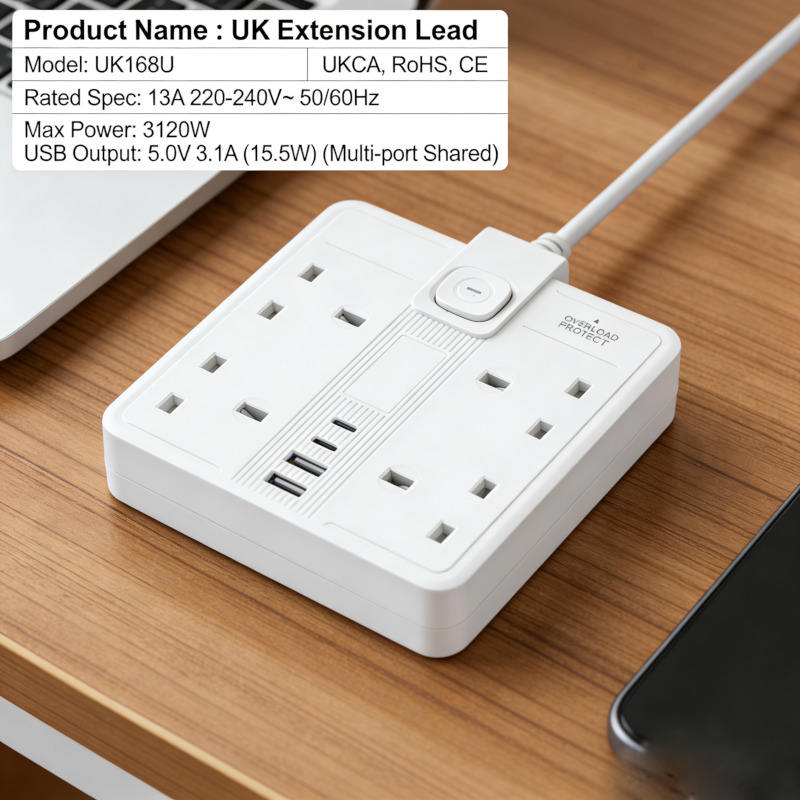
For a UK-style product, 13A and 250V are common specification values, but the final rating must be supported by the productdesign, applicable requirements and test evidence. Do not assume that every tower power strip has the same maximum load.
For example, 13A multiplied by 230V gives approximately 2,990W. This is a mathematical estimate, not proof that a particular product is approved for that load under all conditions.
Before ordering, confirm:
- Rated voltage: The voltage stated on the product label.
- Rated current: The maximum current permitted by the product approved design.
- Maximum total load: The combined load permitted across all outlets.
- Frequency: Compatibility of any integrated electronic modules with the destination market supply frequency.
- USB output: Total output power, supported voltage and current profiles, and relevant protection features.

Why total load matters
A tower design can make it convenient to connect several devices, but the number of outlets does not increase the product total rated capacity.
For example, connecting multiple high-power appliances to a single tower power strip may exceed its rated load even when every socket is occupied by only one device.
Microwave ovens, electric kettles, portable heaters and other high-power appliances require particular care. Buyers should assess the intended applications and ensure that product instructions clearly explain the maximum total load.
Do not select a tower power strip based on outlet count alone. The rated current, cable construction, protective components and intended use must work together.
3. Evaluate Heat Resistance, Flame Resistance and Internal Construction
A tower power strip may be used for extended periods, with multiple devices drawing power simultaneously. Its safety therefore depends on more than the appearance of its outer housing.
For buyers supplying the UK or Gulf markets, it is important to understand the product material specifications and the evidence supporting its thermal performance.
Ask the manufacturer about:
- Housing material: The material grade and the relevant flame-resistance evidence.
- Internal support and insulation: Whether the design maintains appropriate insulation and component positioning.
- Conductive parts: Material, dimensions, contact construction and assembly consistency.
- Temperature-rise performance: Whether the finished product has been evaluated under the applicable test conditions.
- Connection reliability: How the manufacturer controls terminal assembly and electrical contact quality.
A supplier saying that it uses "flame-retardant plastic" is not enough. Request the relevant material specification or test evidence and confirm that it applies to the actual component used.

What should buyers look for in factory quality control?
A reliable supplier should be able to explain how it controls key manufacturing variables, such as material changes, terminal assembly, cable installation and final inspection.
Where available, ask to review relevant test reports and quality records. These provide stronger evidence than general claims such as "premium quality" or "high-temperature resistant."
4. Decide Whether You Need a Regular Tower Power Strip or Surge Protection
A regular tower power strip distributes power to multiple outlets. A surge-protected tower power strip includes additional components intended to limit certain transient overvoltages.
These are different product functions and should not be presented as interchangeable.
If you are purchasing a surge-protected model, ask the supplier for the technical information relevant to the protection design, including:
- The applicable surge-protection standard or test method.
- The specified protection ratings and test conditions.
- The protection components used in the design.
- Whether the product includes an indicator for protection status.
- What happens when a protection component reaches the end of its service life, where relevant.
A joule rating may be useful when comparing products that use comparable test methods, but it should not be treated as a complete measure of protection performance on its own. The applicable standard, protection characteristics and test evidence also matter.
Never assume that a regular power strip provides surge protection simply because it has a switch, circuit breaker or USB ports. These features serve different purposes.
For B2B buyers, the correct choice depends on the product's intended market position. A basic model may suit price-sensitive applications, while a surge-protected version may be appropriate for customers who specifically require that function.
5. Match the Cable Specification and Protection Features to the Load
The flexible cable is a critical part of a tower power strip. Its conductor size, insulation, construction and rated current must be appropriate for the finished product.
Do not select a cable solely because it is cheaper or because it looks thicker.
Ask your manufacturer to confirm:
- Cable type and conductor cross-sectional area.
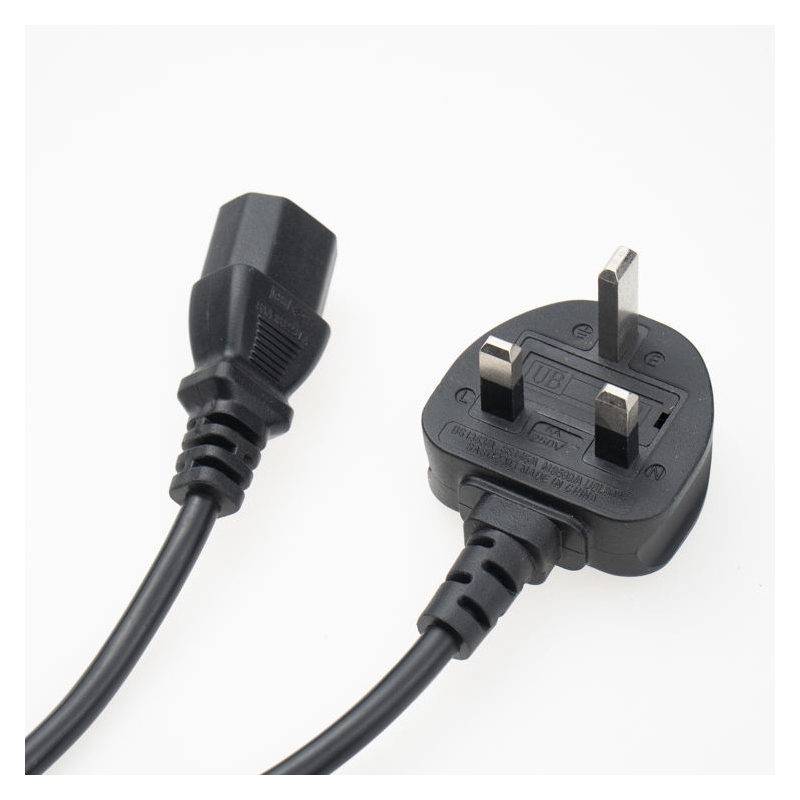
- Number of cores and earthing arrangement, where applicable.
- Rated voltage and temperature classification.
- Cable length and its compatibility with the approved product configuration.
- Strain relief and cord anchorage.
- The relationship between the cable rating, plug fuse and overall product rating.
Does a longer cable automatically cause overheating?
No. Cable length alone does not determine whether a power strip will overheat.
Conductor size, current, cable construction, ambient conditions, installation and product design all affect electrical performance. A longer cable can increase voltage drop and resistive losses when other conditions are unchanged, but there is no universal rule that every cable longer than three metres is unsafe.
For this reason, buyers should request a technically supported cable specification rather than accept a blanket statement that a particular length is always safe or unsafe.
What about overload protection?
Check whether the tower power strip includes a fuse, circuit breaker or other protective arrangement, and confirm that it is appropriate for the product design and applicable requirements.
A switch is not necessarily an overload protection device. Likewise, surge protection and overload protection address different electrical conditions.
The product label, technical datasheet, test evidence and user instructions should describe the actual features accurately.
6. Choose an Outlet Layout That Works for Real Users
Tower power strips often provide outlets across multiple sides or levels. This can save desk space and make it easier to connect several devices.
However, the number of outlets is only one part of the purchasing decision.
Review the following design details:
- Outlet spacing: Can larger adapters fit without blocking neighbouring outlets?
- Socket orientation: Can users insert plugs and remove them conveniently?
- Tower stability: Is the base suitable for the intended placement?
- Switch arrangement: Is there a master switch, individual outlet control or separate control by level?
- USB configuration: If USB-A or USB-C ports are included, are their output specifications clearly stated?
- Cable exit and storage: Does the cable arrangement suit the intended retail or commercial application?
Individual switches or a master switch?
A master switch offers a simple way to control the whole unit. Individual switches may offer more flexibility, but they can add components and affect product cost.
Neither option is automatically better for every customer. The right design depends on the intended application, price point and user preference.
For private-label brands, it is worth testing the outlet layout with representative plugs and adapters before approving the final sample. A tower with many outlets may still deliver a poor user experience if bulky adapters block adjacent sockets.

7. Compare OEM/ODM Capability, MOQ, Lead Time and Total Cost
For importers and private-label brands, a competitive unit price is only one part of the sourcing decision.
A manufacturer should be able to explain which features can be customised, what each change costs and how it affects the production schedule.
| Purchasing item | Questions to ask the manufacturer |
|---|---|
| OEM branding | Can the logo be added to the product, packaging or both? |
| Product design | Which colours, outlet layouts, switch arrangements and USB configurations are available? |
| Packaging | Can the supplier provide customised retail packaging and market-specific instructions? |
| MOQ | What is the minimum order quantity for standard and customised models? |
| Sampling | How long will sample preparation take, and are sample and tooling fees applicable? |
| Mass production | What is the estimated lead time after sample approval and order confirmation? |
| Quality control | What inspections and tests are performed before shipment? |
| Commercial terms | What are the payment terms, quotation validity, packaging costs and shipping arrangements? |
How to assess a manufacturer's quotation
Compare quotations on an equivalent basis. Make sure the specifications, cable length, packaging, protective features, testing scope and certification arrangements are aligned.
A lower quotation may exclude tooling, customised packaging, testing or certification-related costs. Another supplier may include some of these items in the quoted price.
Ask for a clear breakdown of what is included.
Do not approve mass production until the final specification and approved sample are aligned. Changes to the plug, cable, internal components or electrical rating may affect the product conformity assessment and supporting documentation.
8. Check Labelling, Packaging and After-Sales Support
Packaging is not just a branding decision. It also communicates product information and can be important for market compliance.
For products intended for Gulf markets, ask whether Arabic and English warnings or instructions are needed for the specific destination and product category. Confirm the required language, country-of-origin information, importer details and conformity markings with the local importer or compliance provider.
Do not assume that every product must display the same markings in the same location. The requirements depend on the applicable rules.
Before approving packaging artwork, check:
- Product model and rated electrical specifications.
- Required warnings and instructions.
- Manufacturer and importer information, where applicable.
- Country-of-origin marking where required.
- Correct certification or conformity marks.
- Consistency between the product, inner packaging and outer carton.
- Barcode, SKU and shipping-carton information required by the buyer.
If a G-Mark or another conformity mark is required, confirm the approved marking format and any applicable tracking or verification requirements. Do not simply copy a symbol or QR code from another product.
Also agree on how the supplier will handle quality complaints, replacement parts, defective products and changes to the approved design.
A Practical Tower Power Strip Supplier Checklist
Before placing a bulk order, use this checklist to compare potential suppliers.
The target market and applicable compliance route have been confirmed.
Certificates and test reports cover the relevant model and configuration.
Rated voltage, current and maximum total load are clearly specified.
Cable construction and protective features are supported by technical documentation.
Thermal performance and material specifications have been reviewed.
Outlet spacing, switches and USB features suit the intended users.
OEM options, MOQ, sample fees and production lead time are documented.
Product labels and packaging have been checked for the target market.
The final sample and production specification are approved.
Quality control, inspection and after-sales responsibilities are agreed.
A supplier that answers these questions clearly gives you a better basis for evaluating product suitability, production risk and long-term cooperation.
Conclusion: Choose a Tower Power Strip by Evidence, Not Price Alone
A successful tower power strip purchase starts with market compliance and electrical safety, followed by product usability, customisation capability and total sourcing cost.
For UK and Gulf-market buyers, the priority is to verify the applicable requirements, confirm the rated load and cable specification, review relevant test evidence, and approve the finished design before mass production.
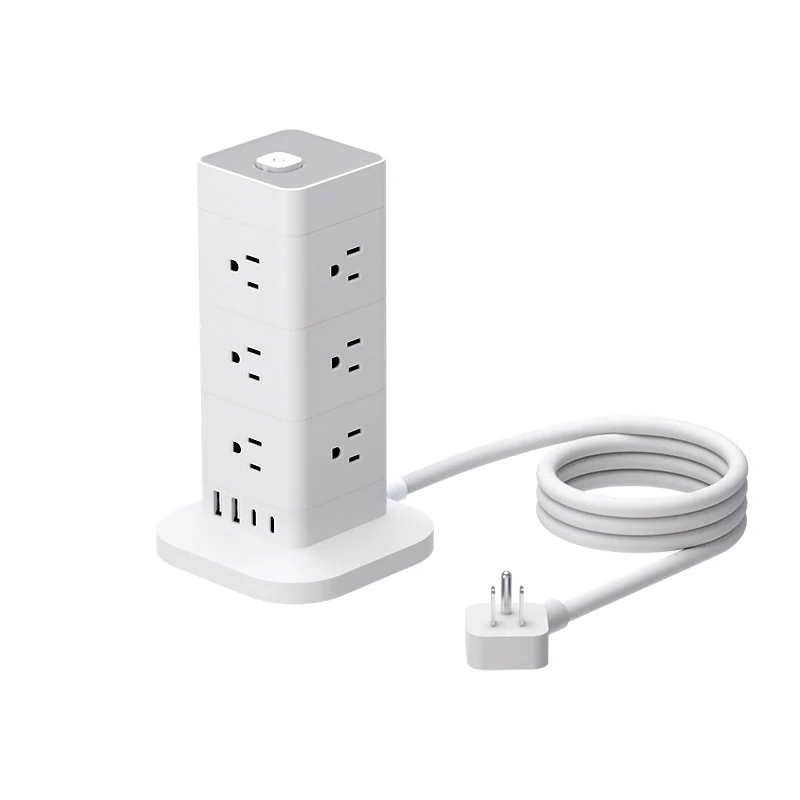
If you are sourcing a Tower Extension Lead under your own brand, work with a manufacturer that can explain its specifications, document its quality-control process and communicate MOQ and lead time transparently.
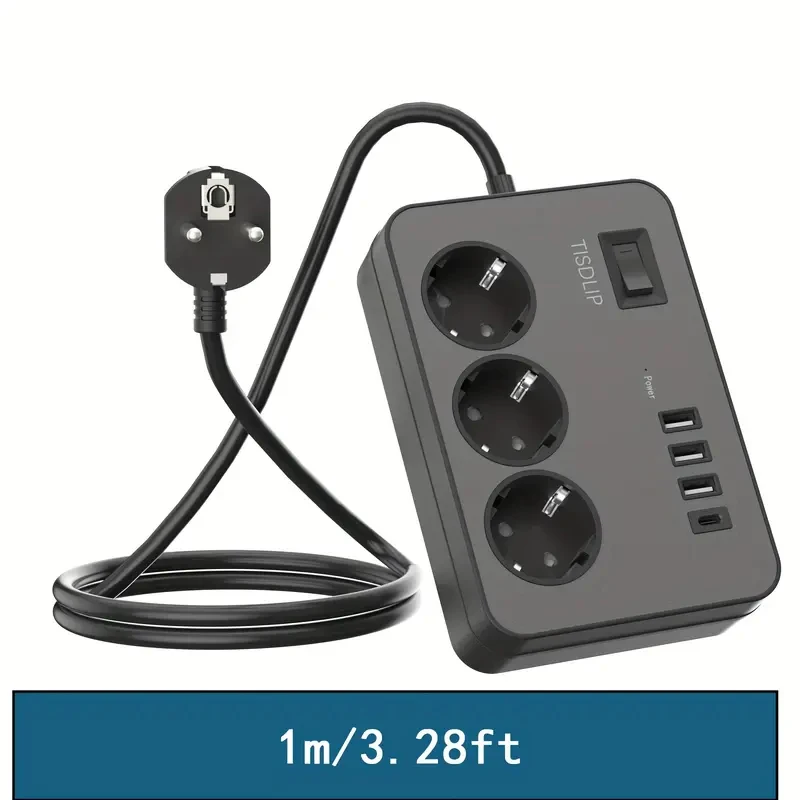
Looking for a tower power strip manufacturer for OEM/ODM projects? Contact TISDLIP with your target market, required plug type, rated current, outlet configuration, cable length, branding requirements and estimated order quantity. These details will help the team assess the appropriate product configuration and prepare a more relevant quotation.
Frequently Asked Questions
1. What should I check before buying a tower power strip in bulk?
Start with the target market compliance requirements, rated voltage and current, maximum total load, cable specification, protective features and supporting test documents. Then review outlet layout, packaging, MOQ and lead time.
2. Does a tower power strip need G-Mark certification?
Not every tower power strip in every market follows the same conformity route. G-Mark applies to products within the relevant Gulf technical regulation and scope. Confirm the exact product classification and destination-market requirements with a qualified conformity assessment provider or importer.
3. Is a 13A Vertical Extension Lead suitable for every appliance?
No. The product permitted load depends on its approved rating and design. The combined load of connected appliances must remain within the product specified limits. High-power appliances require particular care, and users should follow the product instructions.
4. What is the difference between a regular power strip and a surge-protected tower power strip?
A regular power strip distributes power to multiple outlets. A surge-protected model includes additional components designed to limit certain transient overvoltages. Buyers should request the relevant protection specifications and test evidence rather than infer surge protection from the product appearance.
5. Can I customise a tower power strip with my own logo and packaging?
Many manufacturers offer OEM options such as logo printing, colour selection and customised packaging. Available options, minimum order quantities and tooling costs vary by design. Confirm which changes are supported before ordering samples.
6. What information should I provide to get an accurate quotation?
Provide the target market, plug type, rated voltage and current, number and layout of outlets, USB requirements, cable specification and length, logo and packaging requirements, estimated quantity and required delivery date. Existing technical documents or reference samples are also useful.
7. How do I compare tower power strip manufacturers?
Compare suppliers using the same technical specification. Review their relevant test reports, certificate scope, sample quality, quality-control process, customisation capability, MOQ, production lead time and quotation inclusions. Avoid choosing a supplier based on unit price alone.
References
1. GCC Standardization Organization (GSO) — *Guidance for Customs and Market Surveillance Inspectors about the Gulf Technical Regulation for Low-Voltage Electrical Equipment and Appliances.
https://www.gso.org.sa/wp-content/uploads/2021/03/G-Mark_HS_LV_Guidance_V2_English.pdf
2. Saudi Standards, Metrology and Quality Organization (SASO) — *Power Strips Campaign. https://www.saso.gov.sa/EN/CONSUMER_AWARENESS/AWARENESS_CAMPAIGNS/ELECTRICAL_POWER_STRIPS_CAMPAIGN/Pages/campagine_about.aspx
3. Saudi Standards, Metrology and Quality Organization (SASO) — *Non-Conforming Power Strip: Guardian.* This example identifies issues including missing product information, socket-hole design, shutters, conductor cross-sectional area and heat resistance.
https://saso.gov.sa/en/consumer_awareness/noncompliance_products/pages/details.aspx?prod=83
4. International Electrotechnical Commission (IEC) — *IEC 60884-1:2022, Plugs and Socket-Outlets for Household and Similar Purposes — Part 1: General Requirements.* Check the applicable edition and relevant national requirements for the product being assessed.
https://webstore.iec.ch/en/publication/34175



 Email
