

How Much Current Can an 18 AWG Power Cord Handle? UL Rating Guide for OEM Manufacturers
Content Menu
● 1. Understanding AWG: The North American Wire Gauge Standard
● 2. 18 AWG Power Cord Ampacity: Theory vs. Practical Application
>> 2.2 The 80% Continuous Load Rule (NEC 210.19(A)(1) & 210.20(A))
● 3. UL Compliance: Beyond Just Wire Gauge
● 4. 18 AWG vs. 16 AWG Power Cords: Head-to-Head Comparison
● 5. Application Guidance: Choosing the Right Gauge
● 6. B2B Procurement Checklist
● 7. Conclusion: Balance Safety, Performance, and Cost
● 8. FAQ

For international appliance manufacturers, commercial lighting OEMs, and electronic procurement managers targeting the North American market, selecting the correct AC power cord specification is a critical engineering and regulatory decision. A misstep risks not only component failure or excessive voltage drop but also UL certification failure, safety testing issues, and delayed market entry.
Sourcing teams frequently ask:
- What is the real-world continuous current rating for a standard 18 AWG power cord?
- Is 18 AWG sufficient for high-efficiency commercial LED drivers, or should we upgrade to 16 AWG?
- How do UL standards govern cable jacket, conductor configuration, and overall assembly?
There is no single universal number. Safe, compliant ampacity depends on wire gauge, insulation temperature rating, ambient conditions, bundling, and UL/NEC safety requirements. This guide delivers the technical details B2B professionals need for confident procurement decisions.
1. Understanding AWG: The North American Wire Gauge Standard
The American Wire Gauge (AWG) system is the primary standard in North America for specifying the diameter of round, solid, nonferrous electrical conductors. Unlike metric cross-sectional area (mm²), AWG is a geometric, logarithmic system.
Inverse Relationship: Higher gauge numbers indicate smaller wire diameters and lower cross-sectional areas. An 18 AWG wire is thinner than a 16 AWG wire.
Conductor Size Comparison (approximate values):
- 18 AWG: ~0.824 mm² — Common for low-to-medium power consumer electronics, IT equipment, commercial lighting, and small appliances.
- 16 AWG: ~1.31 mm² — Suitable for higher currents, longer runs (to minimize voltage drop), and medium-duty applications.
- 14 AWG: ~2.08 mm² — For high-amperage appliances and heavy-duty use.
Proper gauge selection reduces heat buildup (I²R losses), maintains stable voltage, and ensures long-term reliability.
2. 18 AWG Power Cord Ampacity: Theory vs. Practical Application
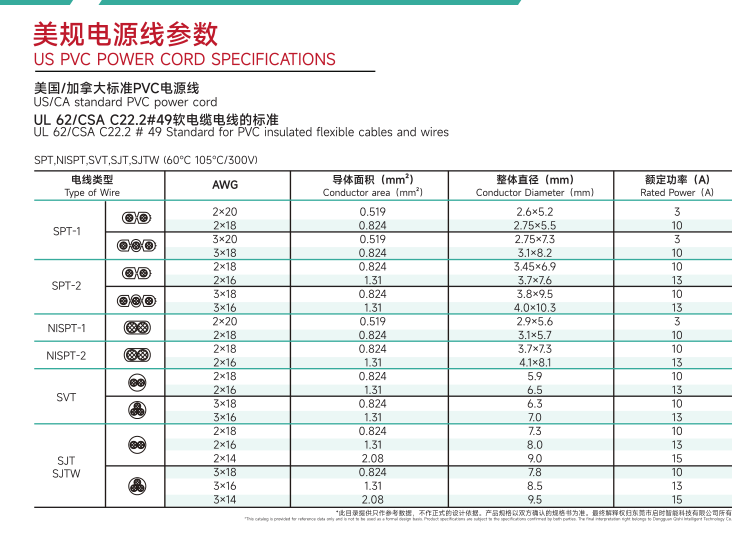
Ampacity is the maximum continuous current (in amperes) a conductor can carry without exceeding its insulation temperature rating under specific conditions.
2.1 Baseline Ampacity by Insulation Temperature (NEC Table 310.15(B)(16) for Copper Conductors in Free Air, 30°C Ambient)
| Insulation Rating | Ampacity (18 AWG Copper) | Typical Applications |
|---|---|---|
| 60°C | 14 A | Standard PVC (SPT-1/SPT-2) |
| 75°C | 18 A | Improved moisture-resistant types |
| 90°C | — (often limited in practice) | High-temp jackets (SJT/SJOW) |
Note: For flexible cords, actual ratings often follow UL 62 and Table 400.5(A) in the NEC, which are more conservative for portable power cords.
2.2 The 80% Continuous Load Rule (NEC 210.19(A)(1) 210.20(A))
A continuous load is one expected to run for 3 hours or more. For safety and compliance:
Safe continuous current ≈ Baseline Ampacity × 80% (or size conductors for 125% of continuous load).
For a typical 60°C 18 AWG cord: ~14 A baseline → ~10–11.2 A safe continuous use. Many UL-listed 18 AWG appliance cords are rated for 10 A (or up to 13 A depending on exact listing and jacket).
2.3 Derating Factors
- Bundling: Multiple current-carrying conductors in close proximity reduce ampacity (adjustment factors apply).
- Ambient Temperature: Above 30°C requires derating.
- Length: Longer cords increase resistance and voltage drop (V_drop = I × R × length).
Always calculate for worst-case conditions to avoid insulation degradation or fire hazards.
3. UL Compliance: Beyond Just Wire Gauge
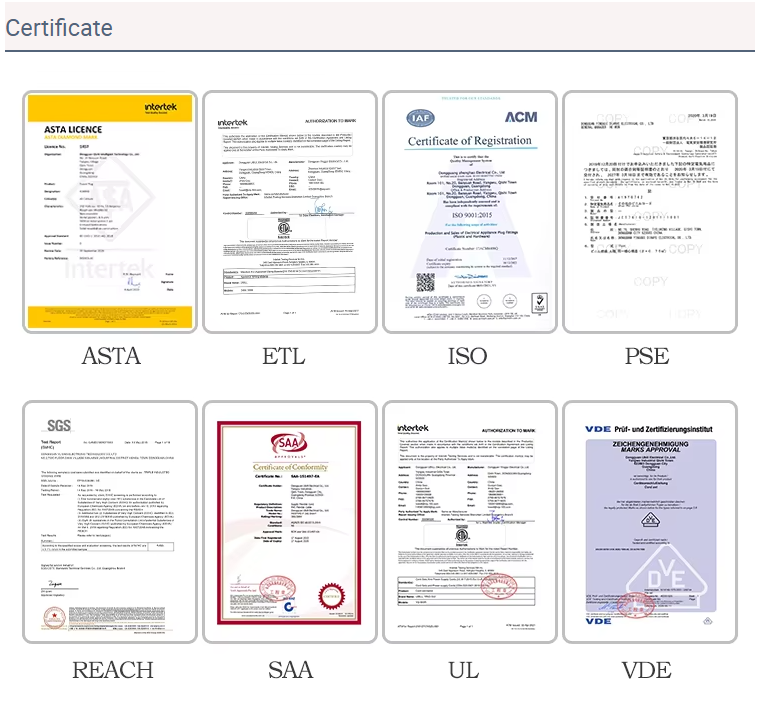
Procurement teams often check only the gauge and overlook the full assembly. A power cord is a complete system (plug + cable + strain relief + terminations).
Key UL Standards:
- UL 62: Flexible Cords and Cables — Covers raw cable construction (strand count, insulation thickness, jacket types like SPT, SVT, SJT; flame retardancy VW-1, etc.).
- UL 817: Cord Sets and Power-Supply Cords — Governs the finished assembly, including molded plugs, pull/flex tests, and dielectric withstand.
- UL 758: Appliance Wiring Material (AWM) — For internal wiring only (not detachable external cords).
Important: Full "UL Listed" marking on the cordset requires compliance with both UL 62 (cable) and UL 817 (assembly). Using UL-recognized wire with a non-compliant plug risks audit failure.
4. 18 AWG vs. 16 AWG Power Cords: Head-to-Head Comparison
| Metric | 18 AWG | 16 AWG |
|---|---|---|
| Nominal Diameter | ~1.02 mm | ~1.29 mm |
| Cross-Sectional Area | 0.824 mm² | 1.31 mm² |
| DC Resistance (@20°C) | ~21 Ω/km | ~13.5 Ω/km |
| Typical Max Rating | 10–13 A | 13–15 A+ |
| Flexibility | Excellent | Good (stiffer) |
| Relative Cost | Lower | 25–40% higher |
| Common Jackets | SPT, SVT, SJT | SJT, SJTW, SOOW |
18 AWG advantages: Better bend radius, lighter weight, lower cost for compact/low-power designs.
16 AWG advantages: Lower resistance, reduced voltage drop on long runs, higher current capacity.
5. Application Guidance: Choosing the Right Gauge
Use 18 AWG When:
LED lighting/drivers drawing <8 A continuous.
Consumer electronics (monitors, chargers, small printers, network gear).
Low-duty small appliances (fans, purifiers) with intermittent loads.
Space-constrained or highly flexible installations.
Upgrade to 16 AWG (or larger) When:
Continuous loads >10 A.
Cord length >15-25 ft (voltage drop concerns).
High-ambient or harsh environments (kitchens, industrial, outdoor).
Heavy motorized or heating equipment.
6. B2B Procurement Checklist
1. Calculate Load: Current (A) = Watts / (Volts × Power Factor). Use 120V and conservative PF.
Example: 800W load → ~6.7 A → 18 AWG suitable.
1500W load → ~12.5 A → Minimum 16 AWG.
2. Specify Environment: SVT/SPT for indoor/light duty; SJTW/SOOW for outdoor/oil/UV resistance.
3. Verify QA & Certification:
100% continuity, Hi-Pot, and pull tests.
Traceable UL file numbers on jacket.
RoHS, REACH, and other required compliances.
7. Conclusion: Balance Safety, Performance, and Cost
For most modern low-to-medium power applications (LED lighting, consumer electronics), a properly certified 18 AWG power cord delivers excellent flexibility, safety, and value. Always prioritize full UL 62 + UL 817 certification over price.
Custom needs—specific lengths, connectors, or compounds—benefit from partnering with an experienced OEM/ODM manufacturer.
Ready to optimize your supply chain? Contact our technical team for samples, custom configurations, and compliant production quotes tailored to your North American projects.
8. FAQ
Q1: Can I use 18 AWG on a 15 A circuit?
No for continuous loads. 18 AWG is typically limited to 10–13 A. Use 14 AWG for true 15 A applications.
Q2: How do I decode the markings on a UL cord?
Example: "SJTW 3/C 18AWG 105°C 300V VW-1
- SJTW: Jacket type (weather-resistant).
- 3/C 18AWG: 3 conductors, 18 gauge.
- 105°C / 300V: Ratings.
- VW-1: Flame test passed.
- Manufacturer's UL file.
Q3: What happens with overload?
Excess current causes overheating, insulation melt, shorts, and fire risk.
Q4: Does length affect capacity?
Thermal ampacity stays similar, but voltage drop increases with length/resistance. Thicker gauge helps for long runs.
Q5: SPT-2 vs. SJT power cord?
SPT-2: Flat, light-duty parallel cord for lamps. SJT: Round, heavy-duty with better abrasion/mechanical protection for commercial use.
References
Underwriters Laboratories Standard for Safety for Flexible Cords and Cables:
UL 62 Standard Evaluation Criteria Underwriters Laboratories Standard for Cord Sets and Power-Supply Cords:
UL 817 Compliance Requirements National Fire Protection Association (NFPA):
National Electrical Code (NEC) Table 310.15 Conductor Ampacities Underwriters Laboratories Appliance Wiring Material System:
UL 758 Industry Style Configurations



 Email
Email