


Heavy-Duty European Extension Cord Buyer's Guide (2026 Professional Edition): Weatherproofing, High-Power Safety Standards, and Technical Selection
Finding a reliable heavy-duty extension cord for outdoor environments—whether for yard work, workshop tools, or demanding construction sites—is essential to maintaining both operational efficiency and job site safety. However, misinformed advice or misleading product descriptions frequently lead to improper buying choices. Choosing an inadequately rated cord not only hampers performance but also poses severe electrical hazards, including short circuits and cable fires.
As an electrical engineering expert, I have consolidated the latest European electrical standards (IEC and VDE), real-world voltage-drop testing data, and professional field feedback into this comprehensive buying guide. This article breaks down the essential technical criteria for choosing a reliable heavy-duty European extension cord (Schuko and CEE standards), helping you avoid costly pitfalls and build a completely secure outdoor power setup
1. Two Critical Buying Mistakes in Outdoor Power Extensions
Mistake 1: Ignoring Ingress Protection (IP) Ratings and Weather Resistance
Many users assume that any rubberized cable is automatically suitable for wet outdoor environments. Using a cable without verified weatherproofing when exposed to rain, mud, or splashing water rapidly degrades insulation, causing short circuits or dangerous electrical shocks
Mistake 2: Mismatching Core Cross-Sectional Area with Power Load
Connecting high-draw heavy equipment (such as electric welders, air compressors, or commercial pressure washers) to an undersized conductor (e.g., 1.0 mm² or 1.5 mm²) results in severe overheating, excessive voltage drop, and potential cable fires under sustained full-load operation
2. The Three Decisive Technical Metrics for Heavy-Duty Extension Cords
To ensure a safe and long-lasting electrical supply, you must evaluate three primary technical indicators.
Metric 1: IP Rating (IEC 60529 Standard)
The Ingress Protection (IP) code indicates an electrical enclosure's resistance to dust and liquid ingress.
IP44 (Base Requirement for Outdoor & Garden Use):
First digit (4): Protected against solid objects greater than 1.0 mm in diameter (e.g., small tools, gravel, or thick wires).
Second digit (4): Protected against splashing water from any direction. An IP44 heavy-duty outdoor extension cord easily copes with rain splashes and garden irrigation.
IP65 / IP67 (Construction Sites and Heavy Industry): In environments exposed to high-pressure water jets or partial submersion, specialized industrial-grade connection systems rated IP65 or higher are required

Metric 2: Conductor Cross-Sectional Area and Load Capacity
The continuous current-carrying capacity of a cable is specified directly on its outer jacket (e.g., 3G1.5mm² or 3G2.5mm²)
3: Indicates three internal cores (Line/Phase, Neutral, Protective Earth)
G: Indicates that one core is a yellow-green Protective Earth (Grounding) wire, mandatory for Schuko plugs
1.5mm² / 2.5mm²: The cross-sectional area of individual copper conductors
According to DIN VDE 0298-4 standards, continuous load ratings for 230V single-phase AC installations are categorized as follows:
| Cable Designation | Conductor Cross-Section | Max Continuous Current | Rated Power at 230V | Typical Applications |
|---|---|---|---|---|
| 3G1.5mm² | 1.5 mm² | 16 A | ~3,680 W | Lawn mowers, hedge trimmers, DIY power tools |
| 3G2.5mm² | 2.5 mm² | 20 A - 25 A | ~4,600 W - 5,750 W | High-pressure washers, arc welders, air compressors |
| 5G2.5mm² | 2.5 mm² (5-core) | 16 A / 32 A | ~11,000 W (400V CEE) | 3-phase industrial machinery, heavy motors, generators |
Metric 3: Outer Sheath Material (H07RN-F vs. Standard PVC)
Cable jacket durability dictates lifespan under physical stress
PVC (Polyvinyl Chloride): Cost-effective for basic light-duty household use。However, PVC stiffens and cracks at temperatures below 0°C and offers poor resistance to oils or abrasion
Neoprene / Heavy Rubber (H07RN-F):
H05RR-F: Lightweight rubber for indoor or mild outdoor use.
H07RN-F (Heavy-Duty Industrial Rubber Cable): Highly resistant to mechanical abrasion, UV rays, oils, and chemicals[cite: 1]. Retains full flexibility across an extreme operating temperature range of -25°C to +60°C, making it the benchmark standard for commercial construction sites
3. Advanced Engineering Insights: Voltage Drop and Cable Reel Safety
Calculating Voltage Drop over Long Extensions
Electricity flowing through long copper conductors experiences electrical resistance, creating a voltage drop. When running cables over 20 m, 50 m, or more under high power draw, the terminal voltage at the appliance can drop below acceptable thresholds (>5%), leading to motor stalling, overheating, or premature tool failure.
Single-Phase Voltage Drop Formula (230V):
L= Cable length (m)I= Operating current (A)γ= Copper conductivity (≈ 56 m / (Ω·mm²))A= Conductor cross-section (mm²)
Running a 3,000W (13A) commercial pressure washer on a 50-meter extension cable:
Using 3G1.5mm²: Calculated voltage drop is ≈ 15.5V, leaving only 214.5V at the tool and generating significant heat along the line.
Upgrading to 3G2.5mm²: Voltage drop falls to ≈ 9.3V, ensuring stable full-power equipment performance and preventing thermal damage.
Cable Reel Thermal Coiling Risks
When utilizing extension cable reels, always strictly follow the safety directive: Fully unreel the cable before applying heavy loads!
Coiled cable acts as an induction coil that traps heat generated by electrical resistance. A coiled reel operated at high load can quickly reach internal temperatures exceeding 80°C, causing the outer PVC or rubber sheath to melt, resulting in immediate short circuits or fire hazards.
4. Scenario-Based Recommendations and Selection Checklist
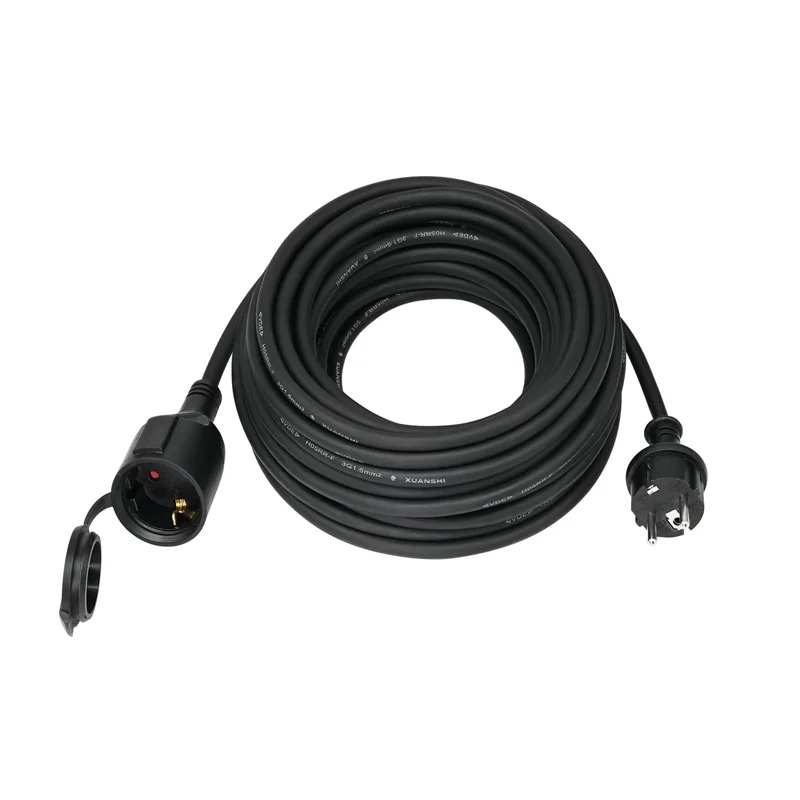
Recommended Setup: Heavy-Duty Outdoor Extension Cord (20m / 50m)
Target Users: Mid-to-large garden maintenance, commercial workshops, site construction, emergency generator hookups.
Optimal Specifications:
Conductor Size: 3G1.5mm² (Residential/Garden)[cite: 1] or 3G2.5mm² (Professional/Industrial)
IP Rating: IP44 or higher
Cable Jacket: H07RN-F Neoprene Rubber
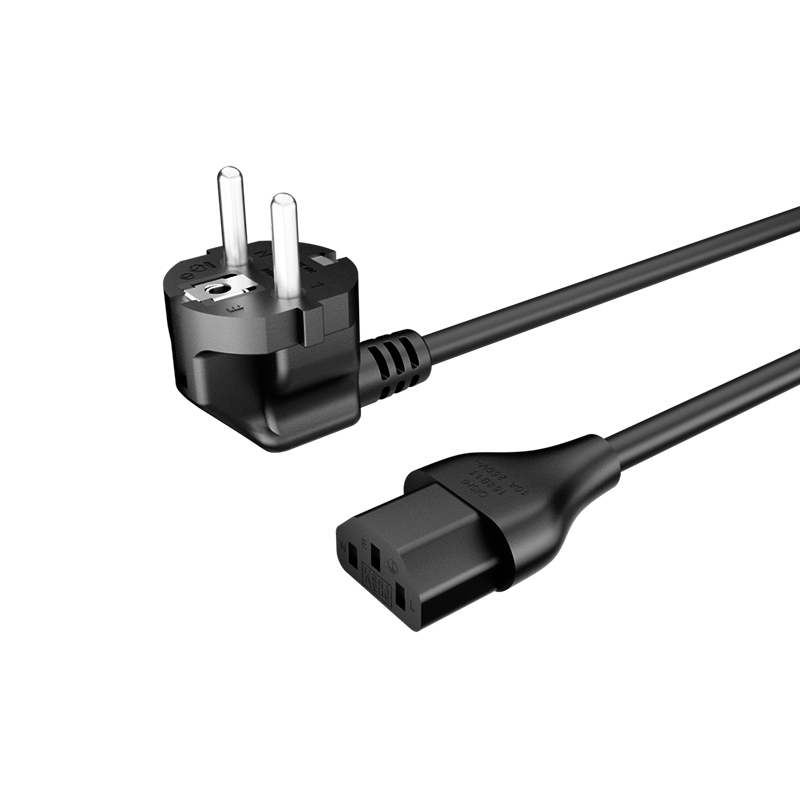
Plug Standard: Schuko Type F with self-closing protective cap
Pre-Purchase Checklist
Certified IP44 or IP65 weatherproofing mark clearly stamped on plugs?
Outer cable explicitly printed with H07RN-F industrial rubber rating?
Does connected equipment exceed 3,000W? If yes, is 2.5 mm² cross-section selected?
Strictly avoid daisy-chaining multiple extension cords together to prevent resistance buildup and water ingress.
5. Conclusion & Actionable Next Steps
Selecting a high-quality heavy-duty European extension cord is an investment in both operational uptime and site safety. For demanding outdoor or commercial environments, prioritize IP44/IP65 ratings, H07RN-F heavy rubber jacketing, and proper conductor gauge cross-sections.
Upgrade Your Job Site Power Supply Today!
Explore our full range of VDE-certified heavy-duty European extension cords and consult our technical specialists to find the precise power distribution solution for your equipment.
Browse Heavy-Duty Extension CordsReferences
IEC 60529 / EN 60529: Degrees of protection provided by enclosures (IP Code). International Electrotechnical Commission. https://www.iec.ch
DIN VDE 0298-4: Capacity of electric cables and conductors for fixed installations and flexible lines. VDE Publishing. https://www.vde.com
DIN VDE 0620-1: Plugs and socket-outlets for household and similar purposes - German Schuko System Standards. VDE Publishing. https://www.vde.com
EN 50525-2-21: Electric cables - Low voltage energy cables - Flexible cables with crosslinked elastomeric insulation (H07RN-F). European Committee for Electrotechnical Standardization (CENELEC). https://www.cenelec.eu
Frequently Asked Questions (FAQ)
Q1: What does an IP44 rating on an outdoor extension cord mean?
An IP44 rating guarantees that the plug and cable are protected against solid particles larger than 1.0 mm and against water splashing from any direction. This makes it suitable for rain exposure outdoors, though it must not be submerged in standing water.
Q2: Is it safe to daisy-chain multiple extension cords together?
No. Connecting extension cords in series is strongly discouraged[cite: 1]. Each connection point adds electrical resistance, increases overall voltage drop, and creates a potential point of moisture entry.
Q3: What is the difference between H05RR-F and H07RN-F rubber cables?
H05RR-F is a light-duty rubber cable rated at 300/500V for light indoor or temporary outdoor use. H07RN-F is a heavy-duty neoprene rubber cable rated at 450/750V, engineered with high resistance to oil, UV rays, and mechanical stress, making it the industry standard for construction sites.
Q4: Why must an extension cable reel be completely uncoiled during use?
When electricity flows through a tightly coiled cable, it creates an inductive thermal effect. Trapped heat cannot dissipate, causing internal temperatures to spike and melt the cable insulation, creating a severe fire hazard
Q5: Should I choose a 3G1.5mm² or a 3G2.5mm² extension cord?
A 3G1.5mm² cord supports up to 16A (≈ 3,680W) and is sufficient for standard garden appliances and light power tools[cite: 1]. For heavy machinery exceeding 3,000W (such as welders or compressors) or distances over 30 meters, a 3G2.5mm² cord is recommended to minimize voltage drop.



 Email
Email