

How to Choose the Right Extension Cord for Safety, Performance & Durability
Content Menu
● 1. What is an Outdoor Extension Cord?
>> 1.1 Technical Definition and Core Use Cases
>> 1.2 Structural Differences: Indoor vs. Outdoor Extension Cords
● 2. Why Specialized Power Cables Are Mandatory for Outdoor Environments
>> 2.1 Ultraviolet (UV) Degradation and Jacket Cracking
>> 2.2 Dielectric Breakdown and Moisture Ingress
>> 2.3 Thermal Stress and Accelerated Mechanical Wear
● 3. Engineering Criteria for Selecting the Right Outdoor Extension Cord
>> 3.1 Understanding Conductor Gauges: AWG vs. Metric Standards
>> 3.2 The Physics of Distance: Managing Voltage Drop
>> 3.3 Application Mapping: Matching Cables to Environments
>>> Residential Exterior & Light Commercial
>>> Industrial Construction & Heavy Machinery
>>> Event Infrastructure & Commercial Entertainment
● 4. Waterproofing and Weatherproofing Classifications
>> 4.1 Deconstructing the "Waterproof" Misconception
>> 4.2 Material Analysis: PVC vs. Synthetic Rubber Jackets
>>> Synthetic Rubber (Thermoset / Neoprene / EPDM)
● 5. Common B2B Procurement Issues and Engineering Solutions
● 6. Manufacturing Quality Control and Structural Integrity
>> 6.1 Raw Material Management
>> 6.2 The Production Process Line
>> 6.3 Mandatory Laboratory Verification Protocols
● 7. Global Regulatory Compliance and Certification Frameworks
● 8. Strategic Vendor Evaluation for B2B Importers
● 9. Frequently Asked Questions (FAQ)
>>> Q1: Can an outdoor extension cord be permanently left out in rain, snow, or sub-zero environments?
>>> Q4: How do I select the proper extension cord specification for high-surge electric power tools?
>>> Q5: Can I connect multiple outdoor extension cords together in a series to extend my reach?
>>> Executive Summary (Brief Introduction)
Choosing the right outdoor extension cord involves understanding several technical factors. For international B2B buyers, procurement managers, and industrial wholesalers, selecting an inadequate power connection can lead to equipment malfunctions, safety violations, or operational downtime. In outdoor environments, electrical cables face relentless exposure to ultraviolet (UV) radiation, temperature fluctuations, moisture, mechanical abrasion, and chemical exposure.
As an established electrical manufacturer with decades of engineering experience, we see firsthand how common misconceptions—like treating indoor and outdoor cables interchangeably or underestimating voltage drop—impact operational safety. This comprehensive guide details the technical specifications of heavy-duty power delivery, bridging the gap between American Wire Gauge (AWG) and European Harmonized (HAR) standards to help you optimize your supply chain.

1. What is an Outdoor Extension Cord?
1.1 Technical Definition and Core Use Cases
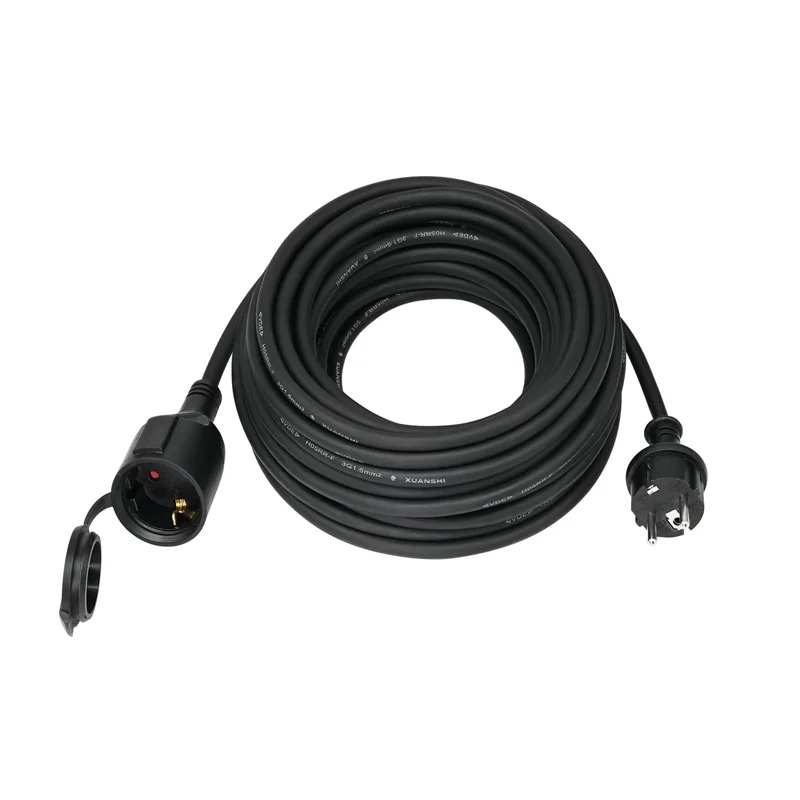
An outdoor extension cord is a specialized, heavy-duty electrical assembly engineered to safely transmit electrical energy through open-air environments. Unlike standard indoor wires, these cables feature structural reinforcements designed to withstand external stressors. They serve as the primary power links for:
* Commercial and Industrial Construction Sites: Delivering power to high-draw machinery, temporary power distribution panels, and heavy drills.
* Agricultural and Landscaping Operations: Operating high-wattage commercial lawn mowers, hedge trimmers, and outdoor pumping systems.
* Event Infrastructure and Outdoor Displays: Providing reliable, continuous power for large-scale entertainment staging, sound systems, and temporary architectural lighting.
1.2 Structural Differences: Indoor vs. Outdoor Extension Cords
The engineering divergence between indoor and outdoor power cables centers on material composition and environmental resilience.
| Technical Parameter | Indoor Extension Cords | Outdoor Extension Cords |
| Jacket Insulation Material | Light-duty PVC (e.g., SPT-1, SPT-2) | Heavy-duty, UV-stabilized PVC or Synthetic Rubber (e.g., SJTW, H07RN-F) |
| Environmental Defenses | Minimal moisture resistance | Highly hydrophobic, UV-resistant, oil-resistant, and flame-retardant |
| Mechanical Abrasion Resistance | Low (susceptible to cuts and crushing) | High (crush-resistant jacket, structural fillers) |
| Temperature Flexibility Range | 0°C to 60°C | Extreme ranges (typically -40°C to 90°C) |
| Standard Amperage Ratings | 1A to 13A maximum | 10A to 50A+ for industrial applications |
2. Why Specialized Power Cables Are Mandatory for Outdoor Environments
Using an indoor-rated cord outdoors introduces severe operational and financial liabilities. The primary risks of using standard indoor components in exposed settings include:
2.1 Ultraviolet (UV) Degradation and Jacket Cracking
Standard polymers lack UV stabilizers like carbon black or specialized hindered amine light stabilizers (HALS). When exposed to solar radiation, photon energy breaks down the polymer chains, leading to embrittlement, surface chalking, and deep structural cracking. Once the outer jacket splits, the primary conductor insulation is compromised.
2.2 Dielectric Breakdown and Moisture Ingress
Outdoor environments present high relative humidity, rain, dew, and ground moisture. Capillary action can draw water into microscopic cracks in substandard insulation. Water lowers the insulation resistance of the cable, creating a direct path for current leakage, which trips Ground Fault Circuit Interrupters (GFCIs) or causes catastrophic short circuits.

2.3 Thermal Stress and Accelerated Mechanical Wear
Outdoor lines are frequently dragged across concrete, run over by vehicles, or subjected to intense temperature shifts. An indoor cord's thin sheath will quickly wear down under mechanical abrasion, exposing live conductors and creating immediate shock and fire hazards.
3. Engineering Criteria for Selecting the Right Outdoor Extension Cord
Selecting the ideal cable requires matching conductor gauge, overall length, and environment to your equipment's power consumption.
3.1 Understanding Conductor Gauges: AWG vs. Metric Standards
Conductor cross-sectional area directly dictates electrical resistance and current-carrying capacity (amperage). The two dominant international standards are American Wire Gauge (AWG) used in North America, and Metric Cross-Sectional Area (mm2) specified under European Harmonized standards.
In the AWG system, the numbering operates inversely: a lower gauge number indicates a thicker conductor, lower electrical resistance, and a higher safe current capacity.
Varop =2.I.L.R
The formula above represents single-phase voltage drop, where I is the current in amperes, Lis the one-way cable length, and R is the conductor resistance per unit length. Thickerconductors (lower AWG or higher mm2) minimize R, allowing safe, high-current transmissionover long distances.
| Conductor Gauge (AWG) | Metric Cross-Section (mm²) | Standard European Code | Industrial Classification | Typical B2B Application |
| 16 AWG | 1.0 mm2 | H05VV-F 3G1.0 | Light Duty | Holiday decorative lighting, small fans, diagnostic tools |
| 14 AWG | 1.5 mm2 | H05RN-F 3G1.5 | Medium Duty | Professional hedge trimmers, portable commercial vacuums |
| 12 AWG | 2.5 mm2 | H07RN-F 3G2.5 | Heavy Duty | Submersible pumps, air compressors, industrial power tools |
| 10 AWG | 4.0 mm2/ 6.0 mm2 | H07RN-F 3G4.0 | Extra Heavy Duty | High-output site generators, temporary power distribution panels |

3.2 The Physics of Distance: Managing Voltage Drop
When current flows through an extension cord, a portion of the voltage drops across the wire's inherent resistance. The National Electrical Code (NEC) recommends keeping the total voltage drop below 3% at the point of load to maintain equipment efficiency and prevent overheating.
* Short Run (15 meters / 50 feet): Standard matching gauges (e.g., 14 AWG for a 15A tool) operate well within safe margins.
* Long Run (30 meters / 100 feet): Voltage drop becomes severe. For instance, running a 15-amp air compressor on a 100-foot 14 AWG cord can reduce voltage from 120V down to under 110V. This causes electric motors to draw more current to compensate, resulting in excessive heat buildup and eventual motor burnout.
* The Procurement Rule: For every 30 meters (100 feet) of length, step up to the next thicker wire gauge (e.g., substitute 14 AWG with 12 AWG) to offset length-induced resistance.
3.3 Application Mapping: Matching Cables to Environments
Selecting the right cord depends heavily on the specific operational environment:
Residential Exterior & Light Commercial
* Core Keywords: `outdoor extension cord for garden`, patio lighting assemblies.
* Technical Requirements: Flexible PVC jackets, standard molded plugs, high aesthetics, 14 AWG to 16 AWG. Suitable for intermittent use.
Industrial Construction & Heavy Machinery
* Core Keywords: `heavy duty outdoor extension cord`, site-grade power arrays.
* Technical Requirements: SOOW or H07RN-F synthetic rubber construction, integrated oil resistance, reinforced strain reliefs, 10 AWG or 12 AWG. Engineered for high mechanical stress and continuous loads.
Event Infrastructure & Commercial Entertainment
* Core Keywords: Stage power distribution, harsh weather exhibition cords.
* Technical Requirements: Highly flexible even in low temperatures, matte black jackets for minimal visibility, multi-outlet configurations, and flame-retardant properties.
4. Waterproofing and Weatherproofing Classifications
4.1 Deconstructing the "Waterproof" Misconception
A common buyer error is assuming a `waterproof outdoor extension cord` can operate permanently submerged. In standard industry terminology, outdoor-rated indicates resistance to environmental moisture, rain splash, and dew, rather than continuous deep-water submersion. True waterproof connection integrity requires specialized IP-rated (Ingress Protection) locking connectors (e.g., IP67 or IP68 enclosures).
4.2 Material Analysis: PVC vs. Synthetic Rubber Jackets
The choice of outer jacket material dictates how the cable responds to environmental stress over time.
PVC (Polyvinyl Chloride)
Cords designated with North American designations like SJT, SJTW, or European H05VV-F use PVC compounds.
* Advantages: Exceptional cost-efficiency, lightweight, highly customizable colors, and built-in resistance to moisture and superficial abrasions.
* Limitations: Tends to stiffen or crack in freezing conditions (below 0°C); less resilient against industrial oils and chemicals. Excellent for standard commercial applications.
Synthetic Rubber (Thermoset / Neoprene / EPDM)
Cords classified under designations like SOOW, SJOOW, or European H07RN-F use thermoset vulcanized rubber.
* Advantages: Extreme operational temperature flexibility (-40°C to 90°C), immune to ozone degradation, and highly resistant to grease, structural solvents, and heavy physical crushing.
* Limitations: Higher manufacturing costs and increased weight per meter. Ideal for mining, oil and gas, and heavy construction fields.
5. Common B2B Procurement Issues and Engineering Solutions
| Observed Performance Failure | Root Chemical / Mechanical Cause | Preventive OEM Engineering Solution |
| Cable stiffens and cracks in cold weather | Standard plasticizers migrate out of the PVC compound, elevating the polymer's glass transition temperature (Tg). | Formulate with specialized low-temperature plasticizers or transition to a synthetic rubber compound (SOOW/H07RN-F). |
| Connector plugs overheat and deform | High contact resistance caused by poor terminal crimping, thin inner copper strands, or blade oxidization. | Use automated solid-pin crimping processes, internal pure copper bridges, and integrated nickel-plated solid brass blades. |
| Jacket splits after UV exposure | Lack of UV-stabilizing additives within the compound recipe, allowing solar radiation to split polymer bonds. | Integrate premium carbon black or specific UV-stabilizer additives into the base outer extrusion formulation. |
6. Manufacturing Quality Control and Structural Integrity
To guarantee performance in harsh conditions, heavy-duty extension cords rely on strict quality control and advanced manufacturing processes.
6.1 Raw Material Management
* Conductor Purity: Premium manufacturers use oxygen-free electrolytic copper ($>99.95\%$ purity) to maintain optimum electrical conductivity and eliminate micro-fissures during drawing.
* Polymer Stability: Virgin resins are used rather than recycled plastics, ensuring consistent insulation thickness and predictable thermal properties.
6.2 The Production Process Line
1. Wire Drawing and Annealing: Copper rods are drawn down to fine gauge filaments and annealed to restore mechanical flexibility.
2. Core Stranding: Filaments are twisted together at precise concentric lay lengths to optimize flexibility and structural memory.
3. Insulation Extrusion: Precision crosshead extruders apply a uniform thickness of primary insulation around each conductor core.
4. Cabling and Outer Sheathing: The insulated cores are twisted with high-tensile fillers and encased in a heavy-duty outer jacket.
5. Direct Over-Molding: Plugs and receptacles are directly injection-molded onto the jacket to create an integrated, watertight, and blast-proof seal.
6.3 Mandatory Laboratory Verification Protocols
Every production batch should undergo rigorous factory testing:
* Continuity and Polarity Testing: Automated verification that internal circuits are correctly mapped without opens or shorts.
* Dielectric Dielectric Withstand (Hi-Pot) Test: Submitting cables to high-voltage stress (e.g., 2000V AC) to confirm the insulation can handle voltage spikes without leaking current.
* Mechanical Flexing and Tension Profiling: Testing the cable's resistance to thousands of severe bending cycles and high pulling forces.
7. Global Regulatory Compliance and Certification Frameworks
To comply with local safety laws and enter major international markets, cables must be certified by accredited third-party testing bodies.
* North American Markets (USA & Canada): Must bear UL (Underwriters Laboratories) or ETL (Intertek) marks conforming to UL 817 and CSA C22.2 standards. These marks certify compliance with fire, shock, and environmental safety codes.
* European Union: Requires the CE mark and alignment with the Low Voltage Directive (LVD). High-tier industrial projects look for the VDE mark, verifying compliance with IEC 60245 (rubber cables) or IEC 60227 (PVC cables).
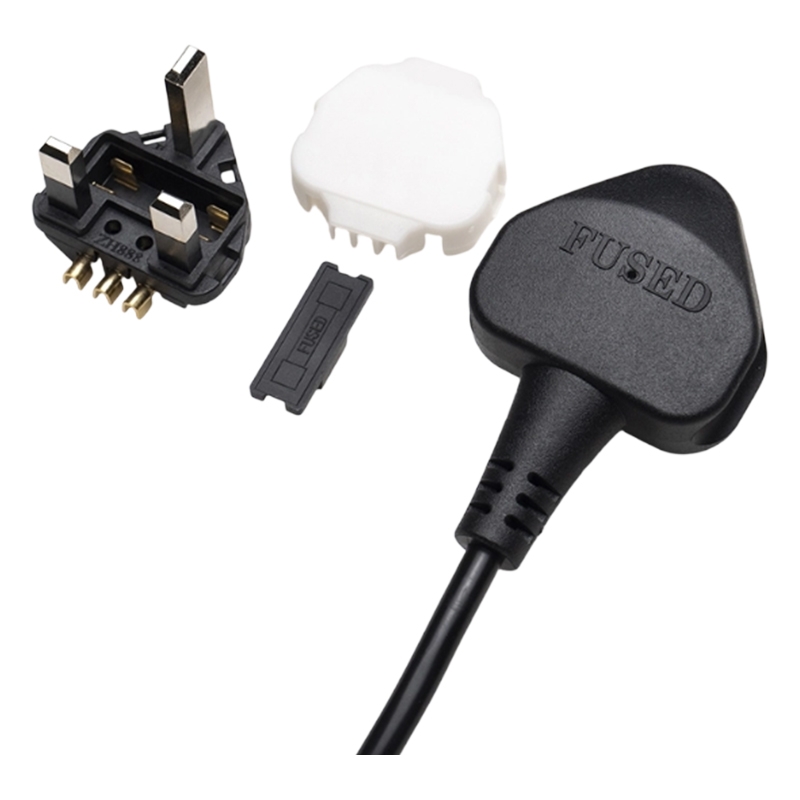
* United Kingdom: Requires the UKCA mark, with cables matching BS 1363 plug specifications and BS EN structural definitions.
* Australian and New Zealand Markets: Regulated via the RCM (Regulatory Compliance Mark), demanding compliance with AS/NZS 3112 for domestic plug styles and AS/NZS 3191 for flexible cords.
8. Strategic Vendor Evaluation for B2B Importers
When selecting an OEM/ODM manufacturing partner for outdoor power distribution lines, look for these key capabilities:
* Verified Direct Manufacturing Assets: Confirm the vendor operates an in-house laboratory, automated compound mixing systems, and dedicated high-speed extrusion lines rather than acting as a trading intermediary.
* Comprehensive Customization Capabilities: The vendor should easily customize length configurations, custom molding shapes, proprietary color matching, and private-label packaging.
* Robust Quality Management Systems: The facility should maintain active ISO 9001:2015 certification, with traceable batch manufacturing records and clear material inspection procedures.
9. Frequently Asked Questions (FAQ)
Q1: Can an outdoor extension cord be permanently left out in rain, snow, or sub-zero environments?
A1: Standard outdoor extension cords (such as SJTW) are designed for temporary outdoor use and exposed weather conditions, but they should not be left permanently exposed to the elements. For semi-permanent installations or extreme environments, specify heavy-duty synthetic rubber cables (SOOW or H07RN-F) combined with sealed IP67/IP68 weather-proof connection enclosures.
Q2: What is the exact functional performance difference between 12 AWG and 14 AWG outdoor extension cords?
A2: A 12 AWG cord features thicker copper conductors than a 14 AWG cord, giving it lower electrical resistance. Consequently, 12 AWG cords safely support higher current loads (up to 15–20 Amps) over longer runs with minimal voltage drop. A 14 AWG cord is limited to medium-duty applications (up to 13–15 Amps) over shorter distances.
Q3: What is the maximum safe production and functional length for an industrial outdoor extension cord?
A3: For standard single-phase power distribution (120V–240V), the practical length limit is 75 to 100 meters (approx. 250 to 300 feet), provided you scale up the conductor gauge (such as using 10 AWG or 4.0 mm2) to offset voltage drop. Going beyond these lengths requires specialized booster systems or shifting to localized portable power generators.
Q4: How do I select the proper extension cord specification for high-surge electric power tools?
A4: Electric power tools with inductive motors can draw up to three times their running current during startup. Calculate this initial surge wattage (W = V imes I), and choose an extension cord rated for that peak load. Generally, heavy-duty tools require a minimum of a 12 AWG (2.5 mm2) cord to handle peak starting currents without stalling.
Q5: Can I connect multiple outdoor extension cords together in a series to extend my reach?
A5: Daisy-chaining cords creates serious fire and electrical hazards. Every plug-and-socket connection introduces additional contact resistance, which accelerates voltage drop and creates localized hot spots. Instead of joining multiple short lines, always use a single, continuous cord of the proper length and gauge for the job.
References
1. Underwriters Laboratories (UL): [UL 817 Standard for Cord Sets and Power-Supply Cords] - Establishes mechanical safety and fire resistance criteria for North American power connections.
2. International Electrotechnical Commission (IEC): [IEC 60245 Rubber Insulated Cables] - Sets global structural standards for heavy-duty rubber-sheathed flexible lines.
3. National Electrical Code (NEC / NFPA 70): [Article 400 Flexible Cords and Cables] - Outlines safe usage guidelines and ampacity tables for commercial and industrial wiring.
4. Occupational Safety and Health Administration (OSHA): [Ground-Fault Protection on Construction Sites] - Mandates specific GFCI and outdoor cable integrity requirements for industrial job sites.
Executive Summary (Brief Introduction)
This comprehensive B2B buying guide provides an engineering-grade breakdown of outdoor extension cords. It covers critical selection criteria, including AWG vs. metric gauges, voltage drop formulas, and PVC vs. rubber jacket performance. Learn how to verify international safety certifications and evaluate manufacturing quality control to protect your industrial supply chain against field failures.



 Email
Email